Propeller-Driven Skateboard
HARDWARE2021-08-15
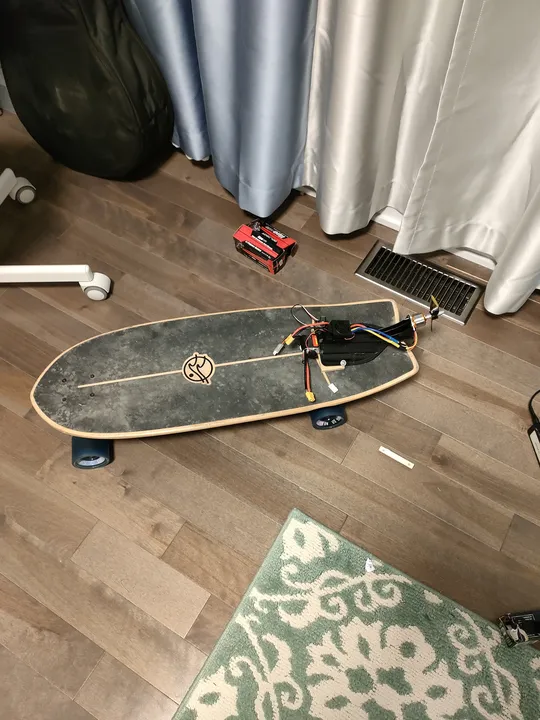
The Idea
I wanted to build an electric skateboard on a minimal budget. Instead of belts or hub motors, I explored using a drone motor and propeller to move the board. The approach is loud and inefficient, but it proved the concept.
How it works
The propulsion system is a high-speed brushless motor mounted to the back of the board.
- Power: 3S LiPo battery.
- Propulsion: A multi-blade propeller displaces air backward to move the board forward.
- Safety Shroud: A fan shroud repurposed as a propeller guard to protect the propeller and hands.
Parts List
- Motor: Brushless motor and ESC.
- Board: Standard skateboard deck.
- Remote: 2.4GHz RC car remote.
Performance
The board moves, but propeller-driven propulsion has significant limitations. It’s louder than belt or hub motor systems and less efficient. The design served as a first exploration into electric vehicle building using available parts, rather than a practical skateboard design.
Built at 12 years 5 months